Sport business reportPadelBy Thomas Lee21 October 2026
The Padel Paradox
A million Britons now play padel, yet many of its professionals still pay their own way. Why does the pro game earn so little from the boom, and is that really a failure?
19.4mpeople play padel worldwide, on 58,300 courtsPlaytomic, 2026
40%of the world's padel players are womenPlaytomic data, via Kimber, 2025
€26,000is roughly what each man earns for winning a P1. A Wimbledon singles champion takes about €4.3m.Padel Earnings, 2026; ATP Tour, 2026
What is happening
Padel has found players far faster than it has found an audience.
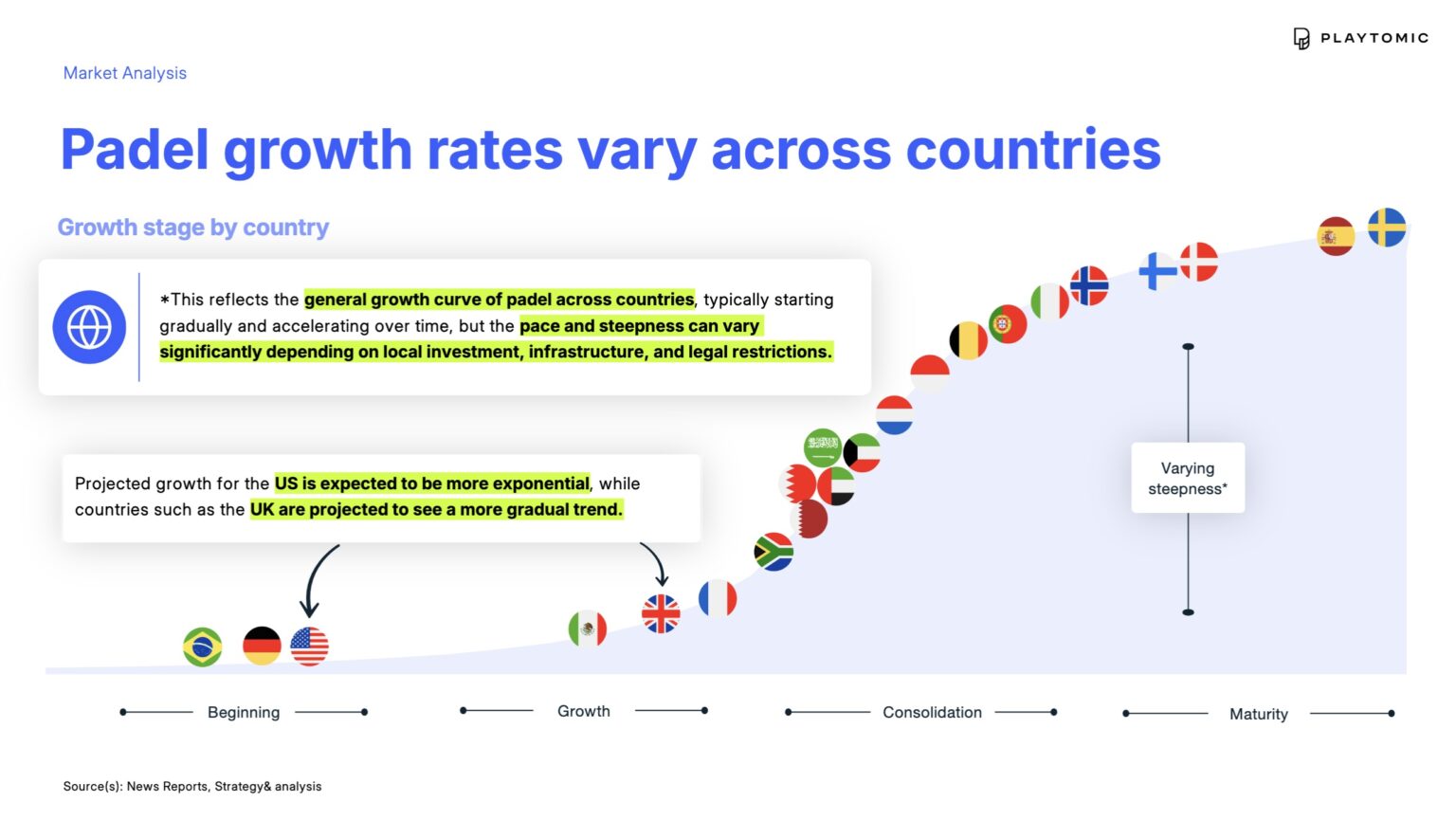
Britain went from 15,000 players in 2019 to a million in 2026 (LTA, 2026a; 2026b). The sport is also maturing. In Spain and France, 80–90% of play is now self-organised open matches rather than lessons, and those matches earn clubs more (Kimber, 2025). Yet the people at the top earn little. Team GB player Nikhil Mohindra points out that pros pay their own travel and physio (Business of Sport, 2026). Losing in the round of 32 at a P1 earns a man about €1,750 and a woman about €1,000 (Padel Earnings, 2026). Only the top 20 or so live well, and they do it on racket-brand contracts with the likes of Head, Babolat and Adidas, not on prize money (Business of Sport, 2026).
British participation rose more than 60-fold in seven years
People playing padel in Great Britain
Source: LTA (2026a; 2026b). 2023–2025 figures are end-of-year counts of people who played at least once in the previous year; 2019 is as reported by the LTA. The May 2026 figure is the LTA headline total and may not be counted on the same basis.
Why the gap exists
Reason 1
Padel is bought to play, not to watch
In a study of 104 players, friendship was the strongest reason to play and social status the weakest (Rodríguez-Cayetano et al., 2023). That shapes what they spend on. An evening of padel competes with a meal out, not with a broadcast. Playtomic's co-founder Pablo Carro admits the sport is "competing with every possible way people can spend their time and attention" (Carro, cited in Kimber, 2025). The habit that fills courts uses up the spare evenings that might otherwise go on watching.
Reason 2
The value sits in the venue
Nine in ten leading clubs now sell off-court services (Playtomic, 2026), and Britain leads the world on gross value per court, up 74% on 2023 (Kimber, 2025). As markets mature and players move from lessons to open matches, clubs earn more per hour. Every step of that growth lands with the operator. None of it is designed to reach the tour.
Reason 3
One paymaster, one pair
Since Qatar Sports Investments announced in August 2023 that it would acquire World Padel Tour, Premier Padel has been the single global professional tour (FIP, 2024). Nasser Al-Khelaifi chairs the tour, QSI and beIN, which shows it in 39 markets (Donaldson, 2026). When one person chairs both the seller and a buyer, the price of those rights may say little about what an open market would pay. The product has also lacked suspense. Coello and Tapia reached 27 finals in a row before losing the Pretoria P1 semi-final (The Padel Brief, 2026). Neale (1964) showed that a sport's product is the contest itself, and a contest needs a credible rival. During that run, the men's game arguably lacked one.
Where padel's money flows, and where it does not
Structure only, not to scale
The missing link: nothing carries club and booking-platform income to the tour. Select any box to see what it is and where the figure comes from.
Premier Padel prize money per player for winning each tier, men and women, in euros
MajorEqual
Men
€48,700
Women
€48,700
P1Women −35%
Men
€26,000
Women
€17,000
P2Women −21%
Men
€14,000
Women
€11,000
For scale
€4.3m
Wimbledon singles champion, 2026. That is about 88 times a padel Major title.
Major figures are for Major I events. Women also play Major II events, which pay a winner €24,750. P1 and P2 men's figures are rounded, as published sources differ slightly. Sources: Binisti (2026); Padel Earnings (2026); ATP Tour (2026). £3.6m converted at £1 = €1.187 (Bank of England reference rate, 19 October 2026, rounded). Bars share one scale, set by the Major. Per-pair figures are double the per-player figures, rounded.
The women's game: the tour's most underpriced asset
Women make up about 40% of the world's padel players (Kimber, 2025), yet the tour pays them less below its top events. The top Majors pay equally, but a woman who wins a P1 in 2026 takes €17,000 against about €26,000 for a man (Binisti, 2026; Padel Earnings, 2026). That is hard to defend commercially. A sport in which four players in ten are women has a ready-made audience for its women's tour. Paying the women's draw less tells sponsors and broadcasters that the tour does not value that audience either.
What golf got right
Golf shows that the gap between the elite game and the amateur can be closed through how the elite game is shown. Sky Sports' Sky Scope turned the sport's best players into volumetric avatars, so viewers at The Open could pause a swing and study it from every angle (Mr MoCo, n.d.). A casual viewer sees the technique they are trying to copy, and the professional becomes someone to learn from, not just someone to watch. The DP World Tour also uses dedicated on-course commentators, among them Wayne Riley (DP World Tour, 2025). Participation has risen alongside. Outside the USA and Mexico, 112.2 million adults and juniors now play, up 4.2 million in a year, with juniors up 3.2 million to 47.1 million (The R&A, 2026). In England, 12.6 million adults played some form of golf in the last year, including 5.3 million away from a traditional course (England Golf, cited in The Golf Business, 2026), and junior club membership rose 34% in 2025 (England Golf, cited in The Golf Business, 2026). Broadcasting did not cause all of that, and these figures do not prove it did. But padel starts with an advantage golf lacks, because amateurs and professionals play on identical courts to identical rules. What it still needs is a way of showing the game that makes its elite level feel close.
What it means commercially
The fix is to connect the tour to where padel's money already sits, without turning the game into a toll road. Sports innovations spread through networks between organisations (Newell and Swan, 1995), and in padel the clubs, the booking apps and the tour barely touch. Partnerships between the three would bring the tour to where players already are. Media rights should be sold openly, and the biggest events should be easy to find and free to watch, because an audience that cannot find the tour will not learn to love it. Golf's example suggests the broadcast matters as much as the rights deal. Padel's glass walls and rebounds can be explained with tracking graphics, on-court analysts and replays that show why a shot worked, so that a new viewer can follow the game almost as quickly as a player can. The technology already exists at club level: GameTraq's AI cameras track every shot and all four players' movement, and had recorded more than 64,000 matches by 2023 (The Padel Paper, 2023). Bringing that kind of data into the broadcast, with replays that show where a pair keeps failing shots, would give viewers the insight coaches already have. And the women's draw should be paid equally, because that is where the next audience is.
Verdict
Padel does not have a money problem. It has a distribution problem. The sport is rich, but its money pools in courts, clubs and booking apps and never reaches the players people might pay to watch. Waiting for an audience to arrive on its own, as the "simply early" case suggests, ignores a structural problem: the tour's owner also chairs one of its main broadcasters, so there is little public evidence that the price of its media rights has been set in an open market.
The fix: build the audience before the invoice. Premier Padel should make its product easy to watch and hard to confuse with anyone else's. That means open tender for media rights, with a free-to-view window for the biggest events; a broadcast that explains the game, with on-court analysts and tracking graphics that show viewers why a shot worked, as golf's coverage does; equal prize money in the women's draw; and partnerships with clubs and booking platforms that carry the tour to the places players already are. It should also tell the sport's own story. The study above found friendship was the strongest reason people play, so a tour that speaks to that community, through its history, rivalries and recognisable personalities, has a better chance of turning players into viewers. Revenue follows an audience, not the other way round.
FIP (2024) Countdown to the Qatar Airways Premier Padel Finals: top 16 players to compete for 2024 titles in Barcelona, 24 October. Available at: https://www.padelfip.com/?p=200801.
Neale, W.C. (1964) 'The peculiar economics of professional sports', The Quarterly Journal of Economics, 78(1), pp. 1–14.
Newell, S. and Swan, J. (1995) 'The diffusion of innovations in sport organizations: an evaluative framework', Journal of Sport Management, 9(3), pp. 317–337.
Rodríguez-Cayetano, A., Aliseda García, V., Morales Campo, P.T. and Pérez-Muñoz, S. (2023) 'Why is padel so popular?: analysis of the reasons for participation and level of intrinsic satisfaction', Padel Scientific Journal, 1(2), pp. 137–156 [in Spanish]. doi: 10.17398/2952-2218.1.137.
Rogers, E.M. (2003) Diffusion of innovations. 5th edn. New York: Free Press.